When building enterprise automation scripts or data processing pipelines, querying a database directly with inline client calls is a common shortcut. In scripts, you frequently see developers initialize a raw MongoClient right inside an endpoint handler or scheduled loop, query a collection without validation, and fail to handle dropped connections or duplicate keys.
Over time, this pattern causes connection pool exhaustion, unhandled downtime, and scattered database logic that is painful to refactor.
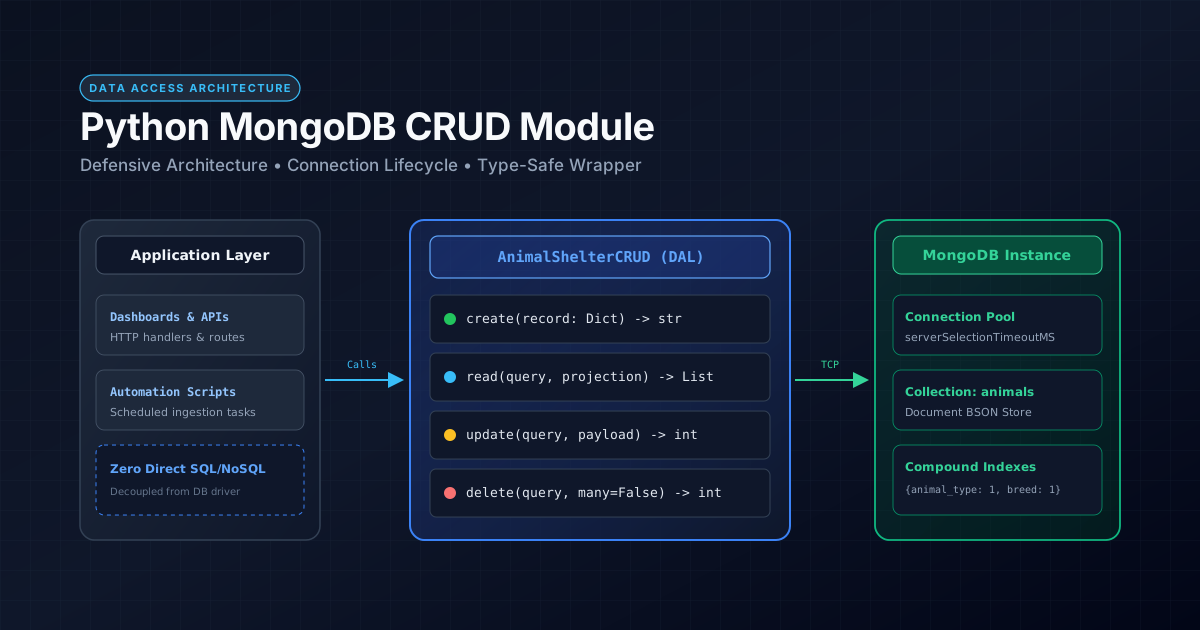
The solution is a dedicated Data Access Layer (DAL)—a standalone, reusable Python module encapsulating all database interactions. In this tutorial, we will build a production-grade CRUD (Create, Read, Update, Delete) module for MongoDB using pymongo.
Evolution: Academic Reference vs. Enterprise Module
To set clear expectations, here is how the architectural design evolved from early prototypes to this published module:
| Capability | Foundational Reference | This Tutorial's Implementation | Future Enhancements |
|---|---|---|---|
| Connection Handling | Hardcoded connection strings with default timeouts | Environment variables (.env) with explicit connection timeouts and ping verification | Dynamic replica set topology failover & secrets manager integration |
| Input Validation | Basic check for empty dictionary | Defensive type inspection, mandatory field checks, and projection sanitization | Schema validation using Pydantic or MongoDB JSON Schema validators |
| CRUD Returns | Bare boolean or raw PyMongo cursor | Predictable structures: IDs for creates, lists of dictionaries for reads, modified counts | Paginated generators (yield) for massive collections |
| Error Handling | Unhandled driver exceptions or silent failures | Granular exception trapping (PyMongoError, ConnectionFailure, DuplicateKeyError) | Automatic exponential backoff retries with circuit breakers |
Environment Setup & Prerequisites
Ensure you have Python 3.10+ installed and the required dependencies installed in your virtual environment:
pip install pymongo python-dotenvStore your MongoDB credentials in a .env file rather than hardcoding them in source control:
MONGO_URI=mongodb://localhost:27017
MONGO_DB=operations_db
MONGO_COLLECTION=animal_shelter
Security Note: If connecting to a remote MongoDB instance (such as MongoDB Atlas or an internal enterprise replica set), ensure your URI specifies TLS/SSL parameters and authentication databases (
?authSource=admin&tls=true). Never commit your.envfile to git.
The Complete Module Architecture
Below is the complete, defensive implementation of our reusable database class, AnimalShelterCRUD. It encapsulates connection management and provides clean, typed CRUD methods.
"""
AnimalShelterCRUD - Reusable Data Access Layer for MongoDB
Author: PM The Tech Guy
License: MIT
"""

import os
import logging
from typing import Dict, List, Any, Optional
from pymongo import MongoClient
from pymongo.errors import (
    PyMongoError,
    ConnectionFailure,
    ServerSelectionTimeoutError,
    DuplicateKeyError
)
from dotenv import load_dotenv

# Configure module logging
logging.basicConfig(level=logging.INFO, format="%(asctime)s [%(levelname)s] %(message)s")
logger = logging.getLogger("AnimalShelterCRUD")


class AnimalShelterCRUD:
    """
    Defensive Data Access Layer for MongoDB collections.
    Provides encapsulated Create, Read, Update, and Delete operations.
    """

    def __init__(
        self,
        uri: Optional[str] = None,
        db_name: Optional[str] = None,
        collection_name: Optional[str] = None,
        timeout_ms: int = 5000
    ) -> None:
        """
        Initialize the MongoDB client using provided arguments or environment variables.
        """
        load_dotenv()

        self.uri = uri or os.getenv("MONGO_URI", "mongodb://localhost:27017")
        self.db_name = db_name or os.getenv("MONGO_DB", "operations_db")
        self.collection_name = collection_name or os.getenv("MONGO_COLLECTION", "animal_shelter")

        try:
            self.client: MongoClient = MongoClient(
                self.uri,
                serverSelectionTimeoutMS=timeout_ms
            )
            # Verify server connectivity immediately
            self.client.admin.command("ping")
            self.database = self.client[self.db_name]
            self.collection = self.database[self.collection_name]
            logger.info("Connected to MongoDB [%s -> %s]", self.db_name, self.collection_name)
        except (ConnectionFailure, ServerSelectionTimeoutError) as err:
            logger.error("Failed to connect to MongoDB server at %s: %s", self.uri, err)
            raise ConnectionError(f"Database connection failed: {err}") from err

    def create(self, record: Dict[str, Any]) -> str:
        """
        Insert a new document into the collection.

        :param record: Dictionary containing document data.
        :return: Inserted document ID as a string.
        :raises ValueError: If the record is empty or invalid.
        :raises PyMongoError: On insertion failure.
        """
        if not record or not isinstance(record, dict):
            raise ValueError("Insertion failed: 'record' must be a non-empty dictionary.")

        try:
            result = self.collection.insert_one(record)
            inserted_id = str(result.inserted_id)
            logger.debug("Successfully inserted document ID: %s", inserted_id)
            return inserted_id
        except DuplicateKeyError as err:
            logger.warning("Duplicate key collision on insert: %s", err)
            raise
        except PyMongoError as err:
            logger.error("Database error during insert_one: %s", err)
            raise

    def read(
        self,
        query: Optional[Dict[str, Any]] = None,
        projection: Optional[Dict[str, int]] = None,
        limit: int = 0
    ) -> List[Dict[str, Any]]:
        """
        Query documents from the collection matching criteria.

        :param query: MongoDB filter dictionary (defaults to all documents).
        :param projection: Field projection dictionary (e.g. {'_id': 0, 'name': 1}).
        :param limit: Maximum number of records to return (0 for no limit).
        :return: List of matching documents.
        """
        query_filter = query if query is not None else {}
        if not isinstance(query_filter, dict):
            raise ValueError("Query filter must be a dictionary.")

        try:
            cursor = self.collection.find(query_filter, projection=projection)
            if limit > 0:
                cursor = cursor.limit(limit)

            return list(cursor)
        except PyMongoError as err:
            logger.error("Database error during find: %s", err)
            raise

    def update(
        self,
        query: Dict[str, Any],
        update_values: Dict[str, Any],
        many: bool = False
    ) -> int:
        """
        Update document(s) matching the query.

        :param query: Filter criteria identifying records to update.
        :param update_values: Dictionary of modifications. Can include raw fields
                              or MongoDB update operators (e.g., $set).
        :param many: If True, updates all matches; if False, updates first match.
        :return: Count of modified documents.
        """
        if not query or not isinstance(query, dict):
            raise ValueError("Update failed: 'query' must be a non-empty dictionary.")
        if not update_values or not isinstance(update_values, dict):
            raise ValueError("Update failed: 'update_values' must be a non-empty dictionary.")

        # Ensure atomic operators like $set are utilized
        payload = update_values if any(k.startswith("$") for k in update_values) else {"$set": update_values}

        try:
            if many:
                result = self.collection.update_many(query, payload)
            else:
                result = self.collection.update_one(query, payload)

            logger.info("Update complete: %d modified out of %d matched.", result.modified_count, result.matched_count)
            return result.modified_count
        except PyMongoError as err:
            logger.error("Database error during update: %s", err)
            raise

    def delete(self, query: Dict[str, Any], many: bool = False) -> int:
        """
        Remove document(s) matching criteria.

        :param query: Filter identifying records to remove.
        :param many: If True, deletes all matches; if False, deletes only the first match.
        :return: Count of deleted documents.
        """
        if not query or not isinstance(query, dict):
            raise ValueError("Delete failed: 'query' must be a non-empty dictionary.")

        try:
            if many:
                result = self.collection.delete_many(query)
            else:
                result = self.collection.delete_one(query)

            logger.info("Delete complete: %d records removed.", result.deleted_count)
            return result.deleted_count
        except PyMongoError as err:
            logger.error("Database error during delete: %s", err)
            raise

    def close(self) -> None:
        """Safely close client connection pool."""
        if hasattr(self, "client") and self.client:
            self.client.close()
            logger.info("MongoDB connection closed.")
Working with Realistic Synthetic Operational Data
Let's test this class using a synthetic operational tracking dataset for an animal shelter or rescue organization. Each record tracks animal demographics, rescue status, and geographic coordinates for GIS reporting.
Synthetic Schema
{
  "animal_id": "A812904",
  "name": "Barnaby",
  "breed": "German Shepherd Mix",
  "animal_type": "Dog",
  "age_upon_outcome_weeks": 52.0,
  "outcome_type": "Adoption",
  "location_lat": 30.2672,
  "location_long": -97.7431,
  "status": "Healthy"
}
Complete Verification Test Script
Here is an end-to-end script that exercises all four operations defensively:
"""
verify_crud.py - Test harness for AnimalShelterCRUD module
"""

from mongo_crud import AnimalShelterCRUD


def run_test_suite():
    # Initialize the DAL instance
    db = AnimalShelterCRUD(
        uri="mongodb://localhost:27017",
        db_name="test_operations",
        collection_name="animals"
    )

    print("\n--- 1. Testing Create ---")
    new_animal = {
        "animal_id": "A999001",
        "name": "Zeus",
        "breed": "Belgian Malinois",
        "animal_type": "Dog",
        "age_upon_outcome_weeks": 78.5,
        "outcome_type": "Pending Training",
        "location_lat": 30.2850,
        "location_long": -97.7350,
        "status": "Evaluated"
    }
    inserted_id = db.create(new_animal)
    print(f"Created record with ID: {inserted_id}")

    print("\n--- 2. Testing Read ---")
    records = db.read(
        query={"animal_id": "A999001"},
        projection={"_id": 0, "name": 1, "breed": 1, "outcome_type": 1}
    )
    print(f"Found {len(records)} record(s):", records)

    print("\n--- 3. Testing Update ---")
    modified = db.update(
        query={"animal_id": "A999001"},
        update_values={"outcome_type": "Dispatched to Search and Rescue"}
    )
    print(f"Updated {modified} record(s).")

    # Verify update
    updated_records = db.read(
        query={"animal_id": "A999001"},
        projection={"_id": 0, "name": 1, "outcome_type": 1}
    )
    print("Record after update:", updated_records)

    print("\n--- 4. Testing Delete ---")
    deleted = db.delete(query={"animal_id": "A999001"})
    print(f"Deleted {deleted} record(s).")

    # Clean up connection
    db.close()
    print("\nAll verification tests completed successfully.")


if __name__ == "__main__":
    run_test_suite()
Engineering Best Practices & Key Takeaways
- Avoid Naked Dictionaries for Updates: Notice how our
update()method automatically wraps raw dictionary fields into{"$set": update_values}if no atomic operator is provided. This prevents catastrophic accidental document replacements when callers pass{ "status": "Active" }. - Explicit Connection Ping: PyMongo creates connection pools lazily by default. Calling
self.client.admin.command('ping')inside__init__forces an immediate network handshake. If MongoDB is down or the network is unreachable, your application fails fast at startup rather than stalling during runtime user requests. - Safe Projection: When fetching operational records for dashboards, always use the
projectionargument to exclude massive unneeded fields (like nested audit logs or raw text). This drastically reduces wire serialization overhead and network latency.
Series Navigation
This guide is Part 1 of our hands-on series on building full-stack Python and MongoDB operations tools:
- Part 1: Building a Resilient, Reusable MongoDB CRUD Module in Python
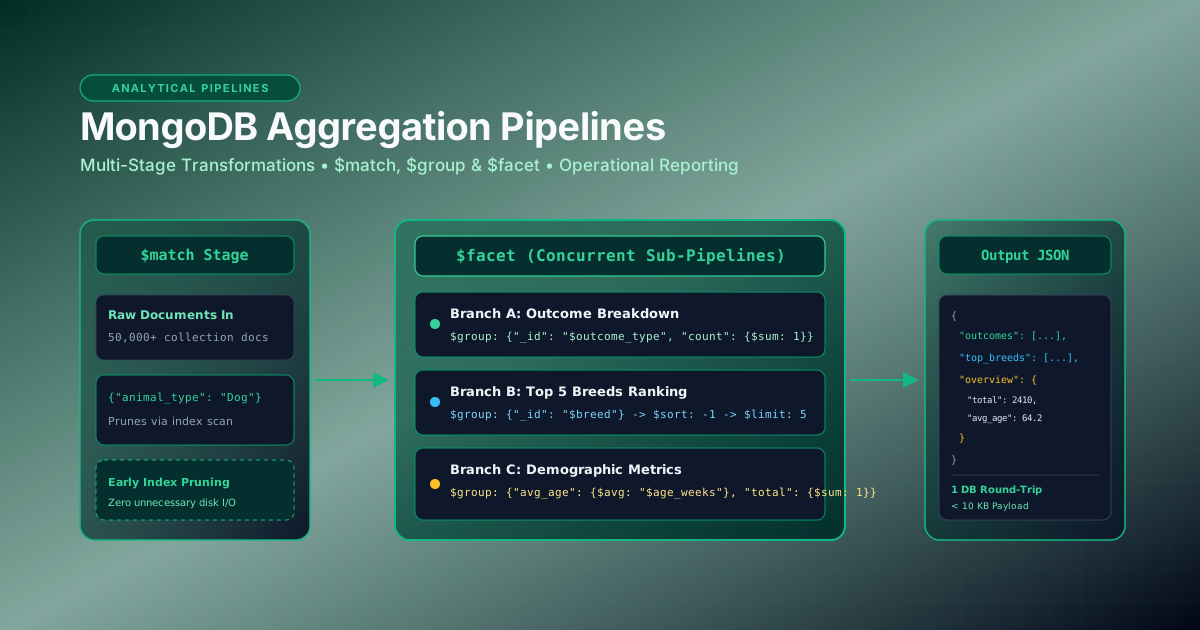
- Part 2: MongoDB Aggregation Pipelines for Operational Reporting
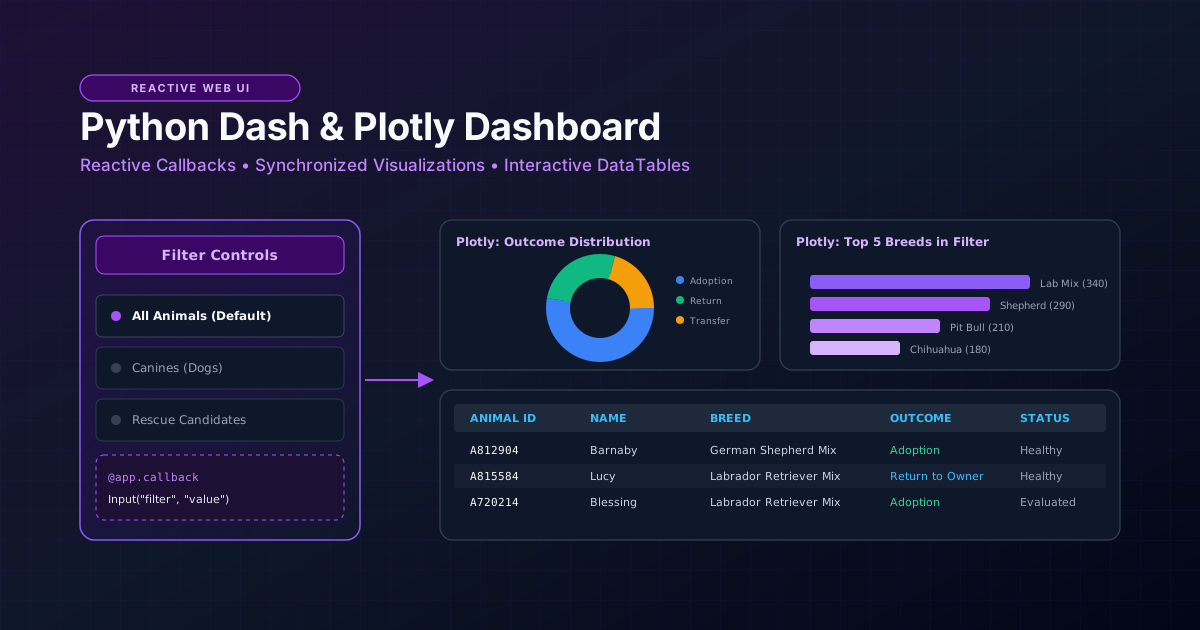
- Part 3: Building Interactive Operational Dashboards with Python Dash and Plotly
- Portfolio Showcase: MongoDB and Python Interactive Operations Dashboard
For related architectural patterns, read Deciding Between Power Automate and Python for Data Pipelines and Structuring Clean Automation Projects.